- Buying & Guides
- Engagement Ring Setting Types
Engagement Ring Setting Types: A Visual Guide
Start with the metal touching the stone. Then look at how high the stone sits and where a wedding band would meet it. The same setting can wear differently in two rings.

What holds the stone in an engagement ring?
Prongs, bezels, tension and flush settings are different ways of holding an individual stone. Pavé, channel, bar and shared prong are common ways of holding a row of accents. A ring can use one technique for its center stone and another on its shoulders, the parts of the band nearest the center.
The head is the assembly that carries the center stone. The shank is the band around the finger. The stone rests in a seat at the girdle, its outer edge. Some prong heads have a gallery rail below the girdle that connects the uprights.
Compare all nine · Check wedding band fit · Use the buying checklist
Visual atlas of nine ring setting types
Find the parts touching the stone. Then follow the metal around the edge to see what it covers. Illustrative macros show white metal and round stones so the construction is easier to compare.
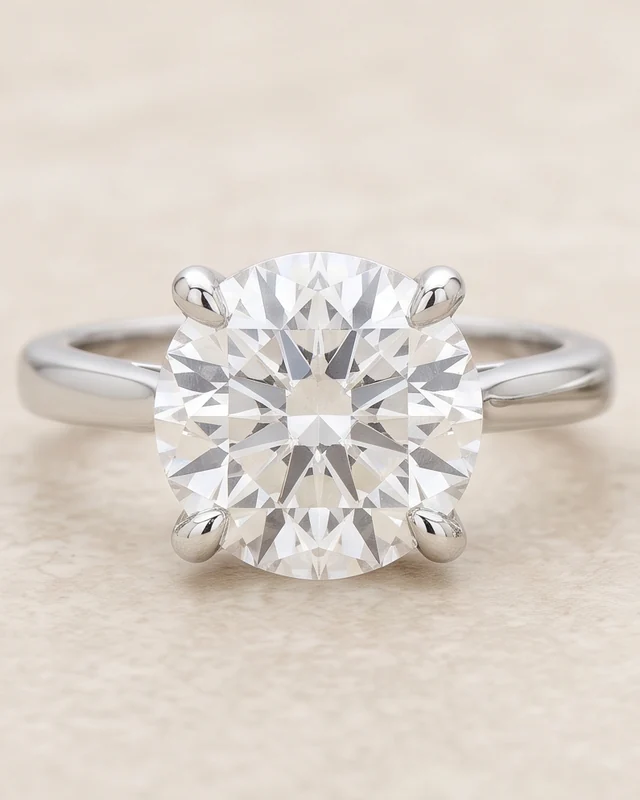
01Prong setting
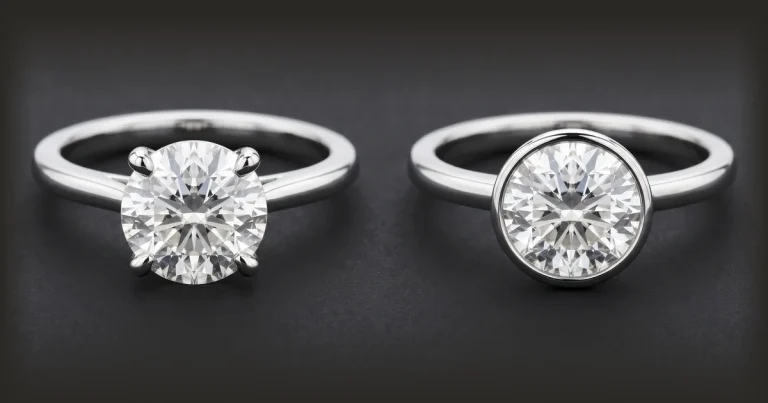
Small metal tips bend over the girdle, the widest edge of the stone. Each prong supports the stone at a fitted seat.
- Look and fit
- Four prongs leave more of a round outline visible. Six add contact points and can change the silhouette. Rounded tips, pointed claws and paired prongs look different. For a pear or princess, ask whether a fitted V-prong covers the tip or corner.
- Wear and care
- Exposed edges can take knocks, and a raised or worn tip can catch fabric. An open basket often gives a brush room beneath the stone. Have a new snag, bent prong or moving stone checked.
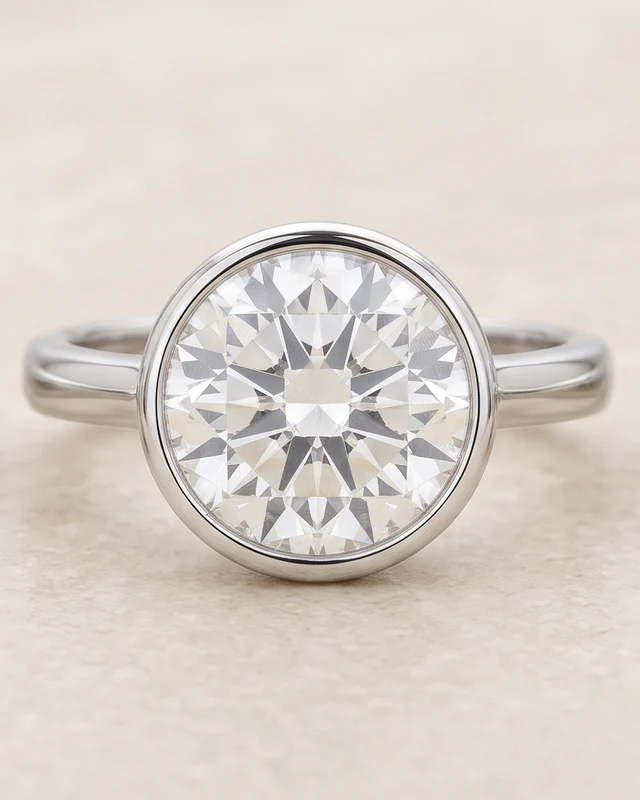
02Full bezel setting
A fitted metal rim reaches over the stone edge all the way around.
- Look and fit
- The continuous border makes the metal part of the outline. A well-fitted rim covers vulnerable girdle edges. This works for many shapes when the rim follows the exact contour, including tips and clipped corners.
- Wear and care
- A smooth rim tends to pass over fabric more easily than projecting tips. Inspect the rim after a blow. Cleaning access below the stone and the work needed for replacement depend on the underside.
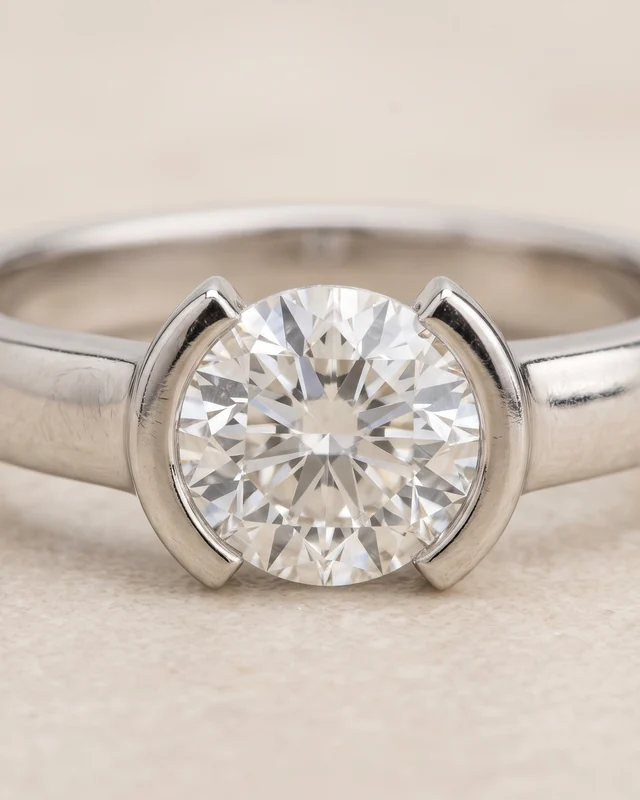
03Partial bezel setting
Separate sections of rim grip the stone. Open sections leave part of the girdle in view.
- Look and fit
- Often called half bezel. On an oval, pear or other directional shape, look at where those open sections land. A visible point outside the rim may need a different layout or its own guard.
- Wear and care
- Edges under the rim have coverage. Bare edges can still meet a hard surface. Ask how the jeweler would clean behind the rim and service one segment if it were damaged.
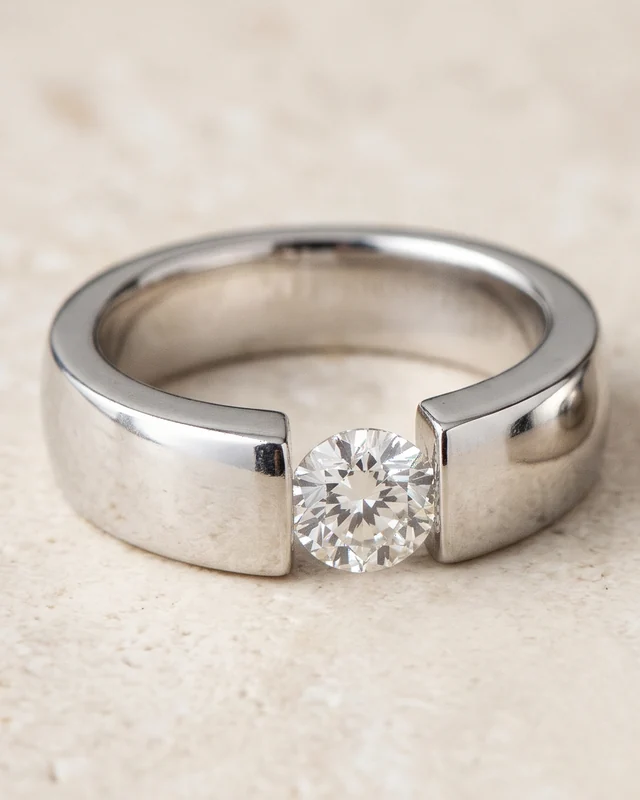
04Tension setting
In true tension, pressure from the spring of the shank holds the stone at precisely fitted contact points on opposite sides. See the two load paths.
- Look and fit
- The stone appears to float in the gap. A tension-style ring can create a similar look with an under-stone bridge or a separate mounting. Ask the maker to identify the actual load path and confirm which stone shapes and dimensions it supports.
- Wear and care
- Open sides make the exposed edge visible and often accessible for cleaning. Ask the original maker about impacts, inspection, resizing and repair before ordering. Do not infer the service policy from the silhouette.
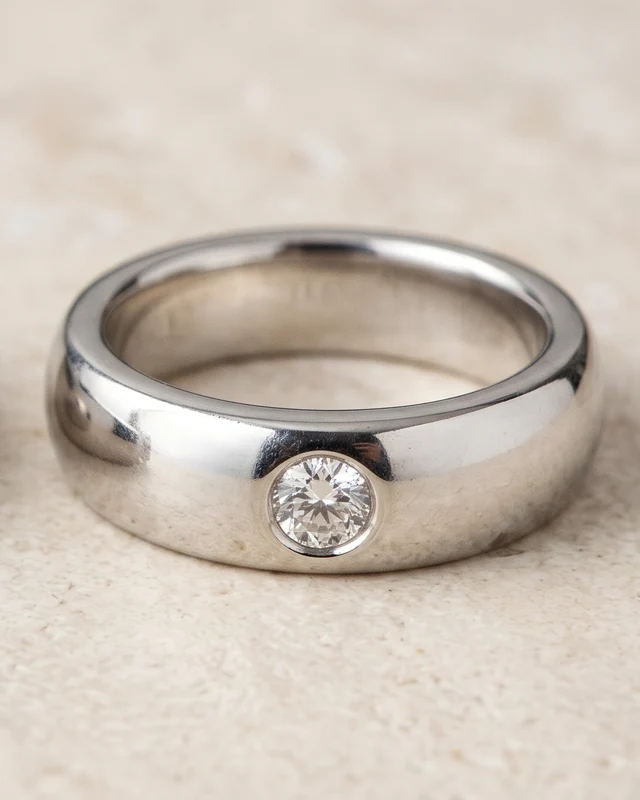
05Flush setting
The stone sits in a recess in the band. Metal from the surrounding surface is worked over its perimeter, with the table near the band surface.
- Look and fit
- Also called gypsy or burnish setting in some catalogs. You see the face of the stone and a broad field of metal. A small round accent is a familiar fit. The band needs enough depth and width for the actual stone.
- Wear and care
- The inset surface can be smooth under gloves and fabric. Residue can collect at the edge, and repair access is limited. Ask how deep a stone the band can accept before selecting it.
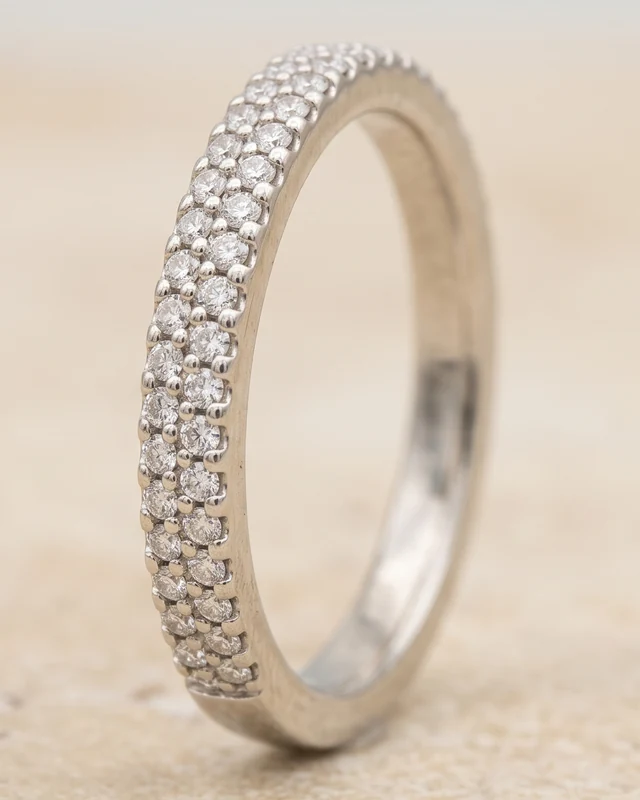
06Pavé and micro-pavé
Small stones sit close together and tiny metal beads grip their edges. Micro-pavé uses very small stones and fine setting work.
- Look and fit
- Usually an accent on shoulders or a halo. Many small flashes can make the band read as a continuous sparkly surface. Pavé describes the setting pattern and appearance. Ask for clear photos because sellers also use it as a broad label.
- Wear and care
- Fine beads and recesses need gentle cleaning and inspection. Ask how a missing accent would be matched and whether the stones stop short of the part of the band used for resizing.
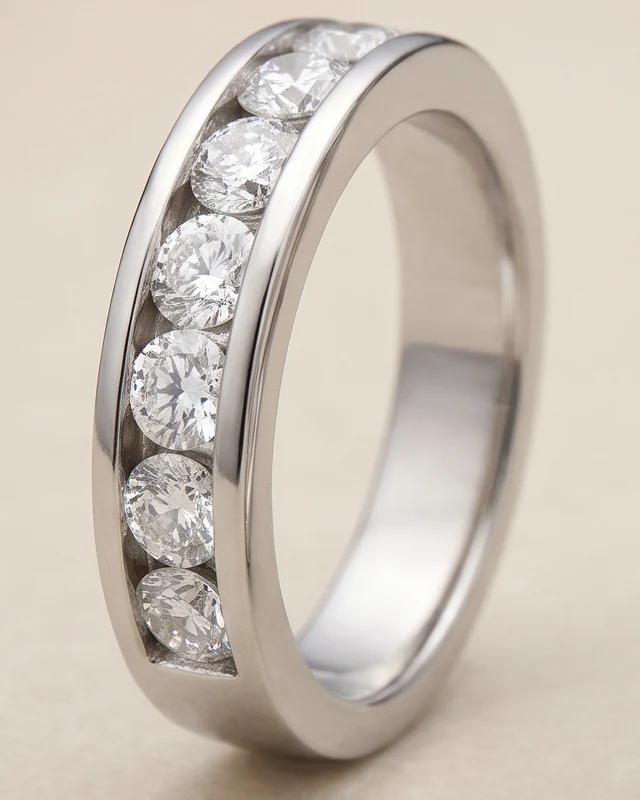
07Channel setting
Two continuous rails cover the opposite edges of stones fitted in a row.
- Look and fit
- The uninterrupted sides form a clean stripe. Rounds, princess cuts and baguettes can all run in channels. Consistent sizes matter, particularly when straight edges are meant to meet.
- Wear and care
- Rails guard the covered sides and can give a smooth outline. Gaps around and beneath the row can hold residue. Bending or resizing the band can change how the rails fit the stones.
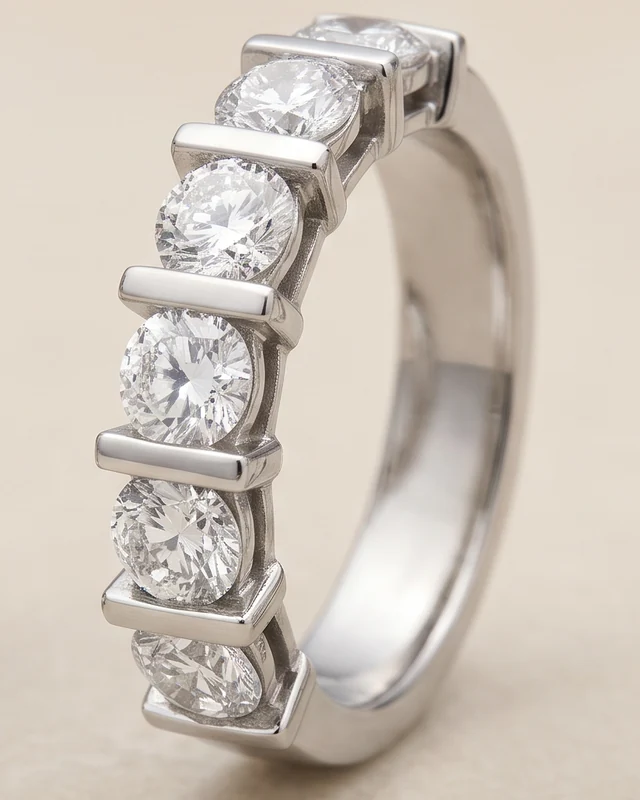
08Bar setting
Short bars cross the row and grip stone edges. A bar between adjacent stones can serve both.
- Look and fit
- The metal creates a visible rhythm across the row. See how it looks with rounds or with baguettes matched to the mounting. Long sides are open between the bars.
- Wear and care
- Open sides give more access for cleaning. Check how much edge is exposed, whether bar ends are smooth, and what the jeweler would do if a bar or one of its neighbors were damaged.
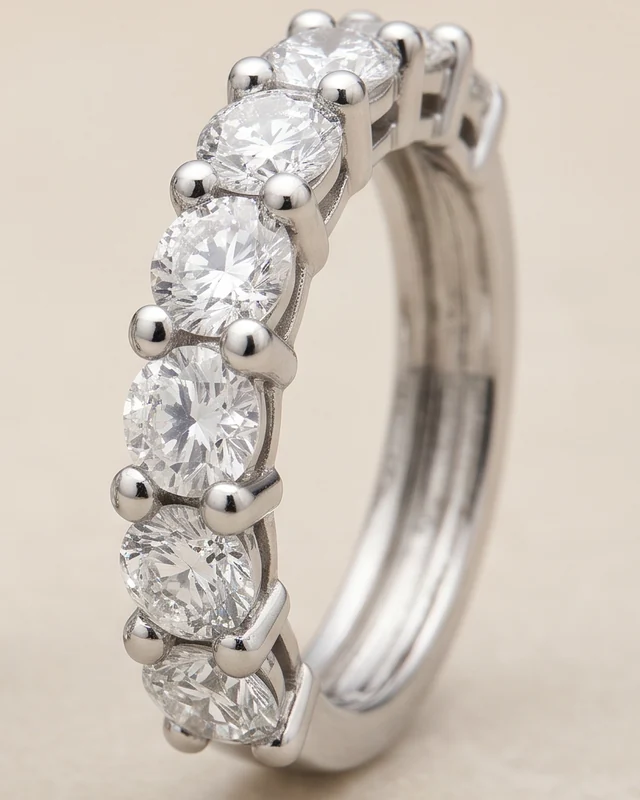
09Shared-prong setting
A prong at the junction grips the edges of two neighboring stones. The photo shows a row with paired contacts at each junction.
- Look and fit
- Rounds are common in this layout. The interrupted metal leaves the sides open. Check the close-up rather than relying on the catalog label, especially with rows also described as pavé.
- Wear and care
- An exposed edge can take a knock. A worn shared prong can affect both adjoining stones, so ask the jeweler to check the row when an accent moves or one contact catches fabric.
What a tension-style ring can hide
How the settings compare in everyday wear
Use the table to shortlist a few designs. Security also depends on how the setting was made, the metal, the stone, wear and maintenance.
| Setting | Metal and exposure | Wear | Inspect |
|---|---|---|---|
| Prong | Separate tips with open spaces | Depends on tip shape, condition and head height | Coverage on points and access beneath the stone |
| Full bezel | Continuous rim shields the covered edge | Generally smooth if the rim is well finished | Fit at corners and access behind the stone |
| Partial bezel | Separated rim sections leave gaps | Smooth at the rim, more exposure in open areas | Which edges and tips are left bare |
| Tension | Opposing shank ends with a visible gap | Open sides and maker-specific service | Actual pressure retention and resizing policy |
| Flush | Edge inset directly into the band | Little projection when the stone is near the surface | Band thickness and room for stone depth |
| Pavé / micro-pavé | Small beads among closely spaced stones | Fine contacts and recesses need inspection | Stone replacement and sizing area |
| Channel | Two continuous rails cover opposite edges | Often a smooth outside profile | Rail fit and whether a size change affects the row |
| Bar | Crosswise dividers with open sides | Bar ends and exposed edges vary by design | Finish of the bars and service access |
| Shared prong | One contact can hold two neighbors | Open sides and interdependent contacts | Whether each prong touches both neighbors as intended |
Solitaire, halo and cathedral describe other parts of the ring
Solitaire, three-stone and cluster
A solitaire centers attention on one main stone. A plain solitaire has no other stones. Some sellers still use the label for a single-center design with small accents on the band. A three-stone design has a center and two distinct side stones. A cluster groups multiple stones into one face. Together they may suggest the outline of a larger gem, or read as a group.
Halo and hidden halo
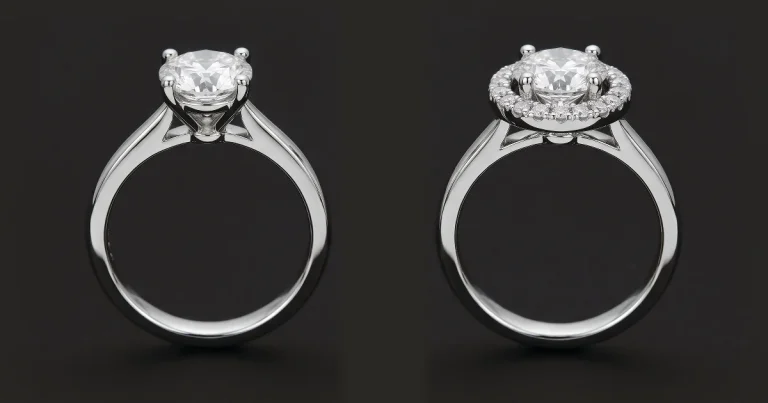
A halo is a ring of accents around the center that you can see from above. A hidden halo sets the accents lower, where they’re mostly visible from the side. Check what holds the center and then how the halo stones are set. On a hidden halo, look from band height to see whether the detail projects toward the wedding band.
Cathedral shoulders and basket heads
Cathedral describes shoulders that rise toward the head from either side. A basket head has supports that link the prongs below the stone. Those features can coexist. On a ring with a plain shank or cathedral shoulders, ask where its lowest projecting part sits and how to clean under it.
Setting height, wedding band fit and care
High vs. low profile
Viewed from the side, a low profile keeps the head closer to the finger and generally presents less to catch on fabric. A taller head can show more of the stone from the side and may leave space for a band underneath. Its height also makes it easier to bump. Compare how the entire head projects as well as where the table of the stone sits.
Check what touches at wedding band height
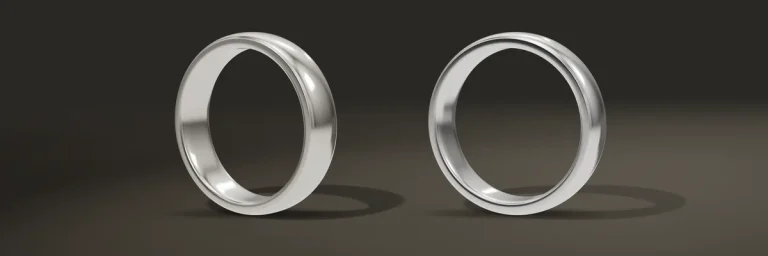
Try the exact engagement ring and band together. Look from the side at the band’s top edge. If it hits the bezel, basket, bridge or side-stone mounting before the shanks touch, try a contour band or choose a deliberate gap. A straight band can sit close when it clears the whole head. Check that hard edges or diamonds on one ring won’t rub the other setting during wear.
Protect corners and plan for service
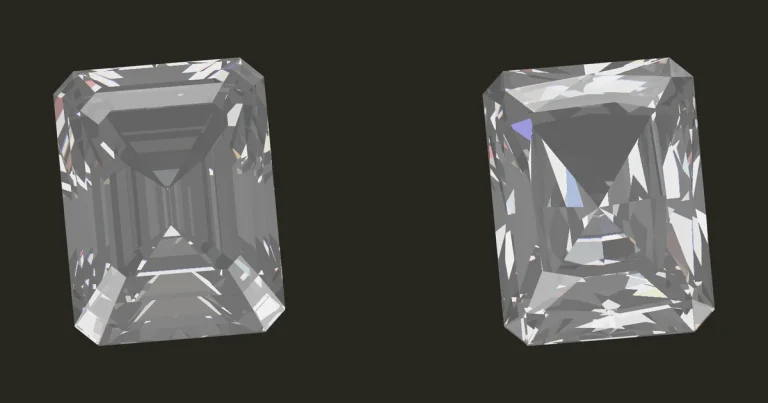
Ask what covers pointed corners, thin girdle areas and exposed tips. A pear or marquise tip can sit in a fitted protective prong or bezel. For rectangular stones, have the jeweler check the actual corners and dimensions, even when different cuts look similar. Read GIA’s guidance on diamond chipping.
Ask how to clean the underside and how often the jeweler recommends an inspection. For a well-set diamond, mild soapy water and a soft brush may be appropriate. Get the jeweler’s instructions for treated stones, mixed gems and damaged mountings. If a stone moves or metal bends, stop wearing the ring and have it checked. See GIA’s diamond care guide.
Before ordering, ask where a size change could be made and whether the maker needs to do the work. Continuous rows of stones or a tension design can limit options. A narrow shoulder, rails and small beads all make workmanship important when a shank is altered.
Which setting suits how you wear a ring?
| Priority | Start here | Check in person |
|---|---|---|
| Work with your hands or wear gloves | Low bezel, or flush accents | Smooth finish and a low profile. Take the ring off for activities where it could catch or take a hard blow. |
| Protect a pear or marquise tip | Fitted rim or protective prong | Look at every point from the side. Ask which edges would meet the counter first. |
| Show the center outline | Open prong design or partial bezel | Compare the actual stone in ordinary light. Check exposed corners and fabric clearance. |
| Wear a straight wedding band | Head with enough clearance above the band | Try the two exact rings together. Check the height and shape of the edge that first touches. |
| Expect a future size change | A design with an unadorned sizing area | Ask for the actual size range in writing, especially with full-circle stones or a tension ring. |
Buying checklist
- Identify what holds the center, what holds any accents and how the head joins the band.
- Check the ring from the top and the side. Ask how the metal protects each point or corner.
- Compare the same stone shape and a similar size in ordinary lighting. An open mounting can reveal more of the side. The cut and lighting strongly affect face-up brightness and flashes.
- Try the wedding band at the correct size and mark where the two rings meet.
- Ask who can clean, inspect, resize and repair the exact ring and what work the maker supports.
Ring setting questions
What is the difference between a ring setting and a ring style?
A setting is how a stone is held. A style can describe the stone layout or the ring’s silhouette. A solitaire can use prongs or a bezel, and either version can have cathedral shoulders.
Do six prongs hold a diamond better than four?
Six give the stone extra contact points when the prongs are properly placed and fitted. Seat fit, metal thickness, wear and coverage of corners also matter. Inspect the workmanship on the exact ring.
Which setting should I consider if my ring catches on gloves?
Try a smooth low bezel or a band with flush-set accents first. Run a finger around the edge and look for a prominent head or tips. Even a low ring can catch or take a hard knock during physical work.
How do I tell a tension ring from a tension-style ring?
Look beneath the stone for a bridge, cradle or separate mounting, then ask the maker what holds the stone in place. On a true tension design, the spring of the shank provides the grip. A photo alone cannot establish that.
Can a low-profile engagement ring sit flush with a straight wedding band?
Yes, if nothing projects into the band’s path at that height. Check for contact with the basket, bridge, bezel or a side stone. Try the exact rings together to see the contact and any gap.
Do prongs make a diamond sparkle more than a bezel?
Prongs often reveal more of the edge and side facets. Face-up brightness and the pattern of flashes depend strongly on the diamond’s cut and the lighting. Compare the actual rings in the same light with clean stones.
Can pavé, channel-set and tension rings be resized?
It depends on the design and maker. A stretch of plain shank can leave room for a size change. A full-circle row or a true tension design can limit options. Ask for the permitted range and whether work must go back to the maker.
Is pavé the same as shared prong?
A pavé layout usually looks like a surface covered by small stones held by tiny beads. Shared prong describes a contact that grips two neighboring stones. Descriptions can overlap, so look for how the stones are actually held.