Solitaire vs Halo Ring: How to Choose
Give the center stone the whole field of view, or frame it with a row of accents. See what each design changes on the hand and what to check before buying.

- Solitaire Ring
- Single focal stone
- Halo Ring
- Center framed by accents
A single focal point or a wider frame?
Compare the finished-ring quote, the profile against your wedding band and the shop’s service terms.
Compare face-up sizeSee classic and hidden halosChoose by priority
| Factor | Solitaire | Classic halo |
|---|---|---|
| Stone layout | One center stone is the focus. | A row of small stones frames the center. |
| Face-up outline | The center and its mount define the head. | The outer edge of the frame defines more of the outline. |
| Sparkle pattern | Flashes are mainly from the center stone. | The accents add small flashes around the center. |
| Setting quote | Depends on the head, metal and workmanship. | Includes the accents and the work to set them. |
| Care and inspection | Check the center’s contacts and access under the stone. | Also check the small stones, beads and the recesses around them. |
| Fit and resizing | Check the basket, profile and part of the band that can be sized. | Check the head edge, gallery and any accents extending down the band. |
Compare the center stone and the whole outline
Separate the layout from the way the stone is held
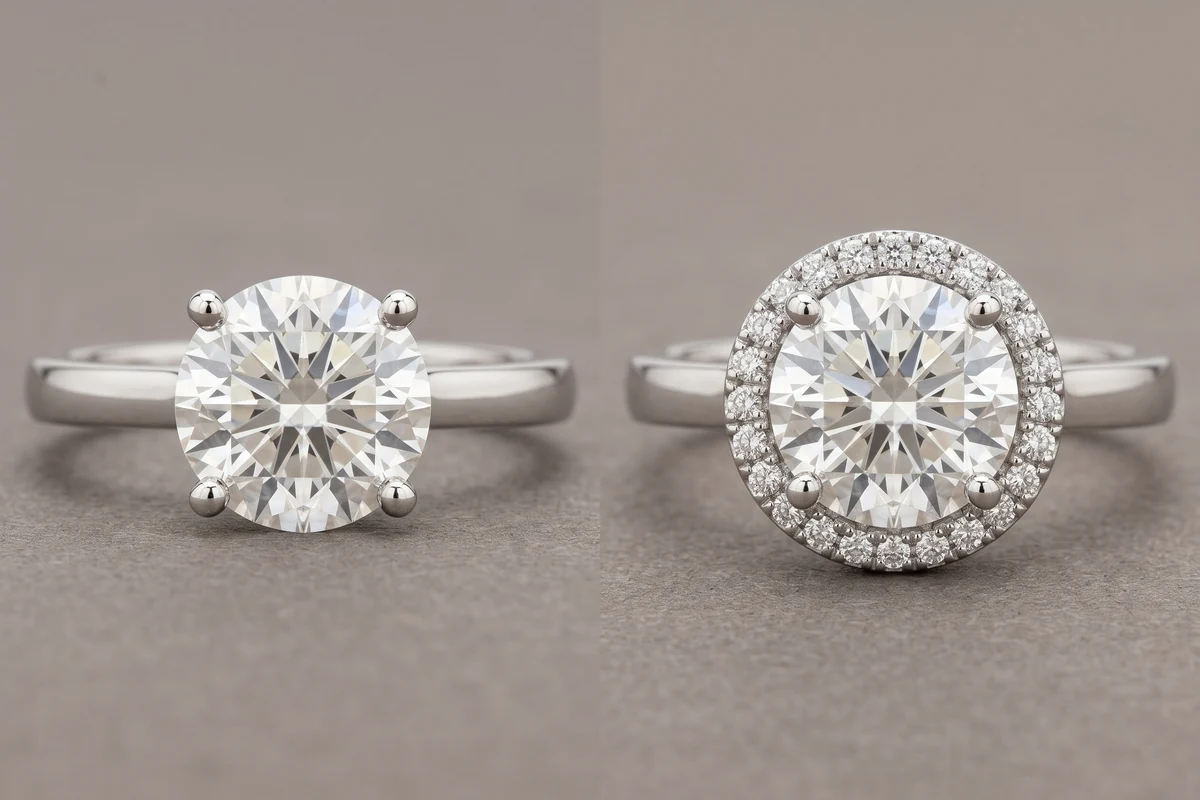
A solitaire has one focal stone. A classic halo arranges smaller stones around the center. These are two layouts. Check how the center is held in either ring. Prongs, a bezel or another fitting can secure it independently of the accent stones.
Ask for two measurements
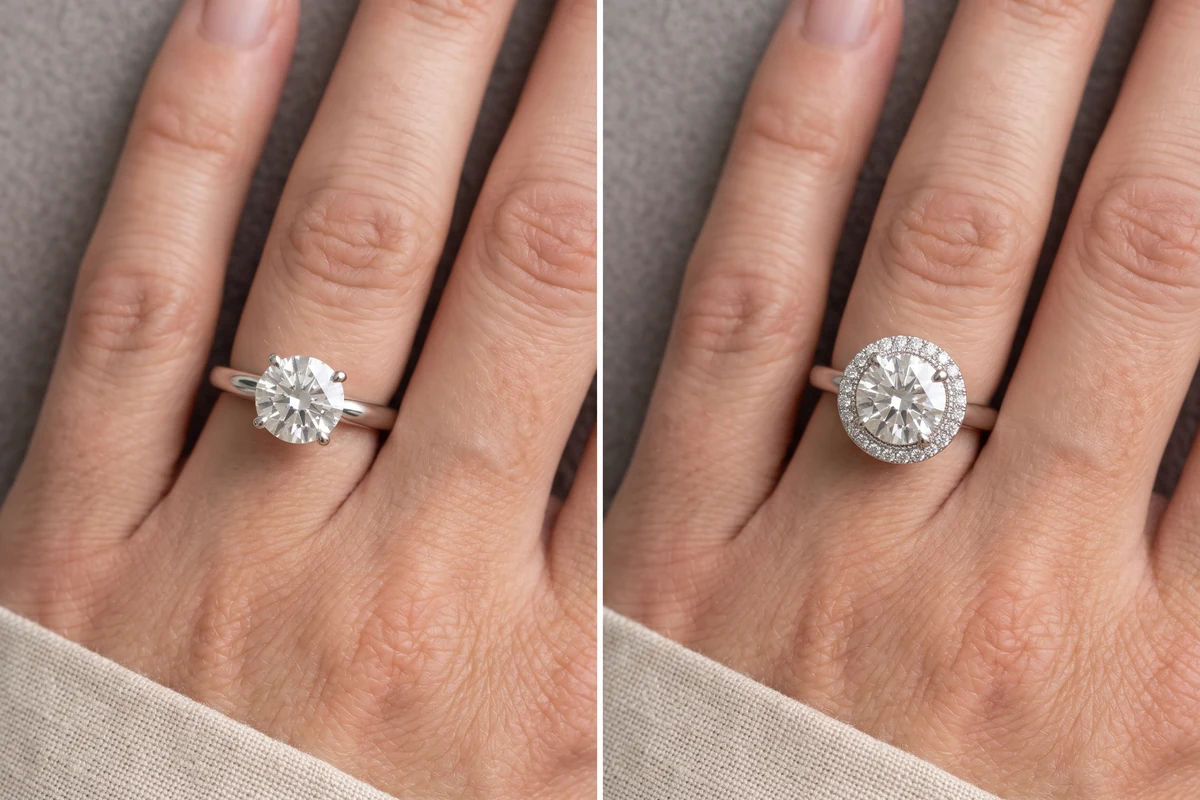
Ask for the center stone’s face-up dimensions and the overall width of the ring head. A halo can make the composition look broader and sometimes make the center look larger. The stone’s dimensions and carat weight stay the same. On an oval or other elongated design, compare length as well as width.
The accents add their own reflections. Compare both rings under the same light. Watch the center for its pattern of flashes, then watch the perimeter. This shows where you see the sparkle as the ring moves.
Classic halo and hidden halo from the side
Classic halo puts the frame in view
The accents sit around the center and are visible face-up. A single halo gives one border. A double halo adds a second row, which can add width and detail. Compare the finished shape and ask how the inner and outer accents are set.
Hidden halo puts the accents below the center
A hidden halo usually runs around the gallery below the center stone’s edge. It can look close to a solitaire head-on and show more detail when the hand turns. How much shows from above depends on the gallery, center shape and angle. Ask for photos from above, the side and at wedding-band height.
Try it on with the wedding band
Look where the rings actually meet
A plain solitaire can have a low basket, and a halo can be raised to leave clearance. With both rings on, look from the side for the first point of contact. See whether the wedding band reaches the engagement ring’s shank, touches the head or meets the hidden accents. If a gap bothers you, test a curved band or a different head profile.
Check the profile against your daily routine
Look for projecting edges, high prongs and a head that feels wider than you want between fingers. If you wear gloves or remove rings often, ask to try on a sample in the same profile. To translate a known size into another system, use the Ring Size Converter and confirm the fit with the jeweler.
Compare the quote and the work it may need
Hold the center stone constant for the first quote
Request both prices with the same center stone, or match gem type, dimensions and relevant quality characteristics. Keep the metal, band width and finish comparable. Ask the shop to itemize the mount, accent stones and setting labor. A halo can cost more to make with the same center. A solitaire with a costly center or custom head can still cost more overall.
If your priority is the finished outline, ask for a second comparison. Price the two rings that give approximately the coverage you want, then decide whether you prefer a larger single focal stone or a wider frame of smaller stones. Confirm whether the listed carat weight is for the center alone or a total.
Ask how they would maintain the small stones
Any stone can loosen if the metal holding it wears or bends. A halo adds more seats to inspect and can leave narrow areas that are harder to reach. If an accent is loose or missing, stop wearing the ring and have the mounting checked. Ask whether the jeweler can match the size, shape and appearance of a replacement, and what the warranty covers.
Clean for the whole assembly
Ask for care instructions that cover the center, all accent stones and the metal. For a ring the jeweler confirms can be brushed, check whether you can reach beneath the head and around the accents. Get a professional check before using steam or ultrasound if you are unsure about the gems, treatments or settings. See GIA’s jewelry care guidance.
Ask which part of the band can be resized
Find out whether the underside has plain metal available for a size change. Accents extending around the shank can complicate sizing. A halo around the head and a row along the band affect different parts of the ring. Ask about the exact size range, whether the head will need checking after the work and who can do the repair.
Buying decision matrix
| Your priority | Try first | Verify before buying |
|---|---|---|
| A clearly defined center | Plain-band solitaire | See the center edge from above and the grip from the side. |
| A broader outline at a given center size | Classic halo | Compare center dimensions and outer head width separately. |
| Detail visible as your hand turns | Hidden halo | View the gallery at band height and check cleaning access. |
| Stay within a total budget | Matched quotes for both layouts | Separate center, mount, accents and expected service. |
| Simple upkeep and daily wear | A low, accessible example of either layout | Look for catch points and ask who will inspect or replace stones. |
| Wear an existing wedding band | An engagement ring tried with that band | Check clearance, contact and whether you like the gap. |
Solitaire and halo questions
Will the same center stone look bigger in a halo?
A classic halo adds width around it, and that outline can make the center seem larger. The stone keeps the same dimensions. Compare the center and outer head measurements if you are deciding how the ring will cover the finger.
Is a hidden halo visible from above?
It usually shows most from the side. In some designs, accent stones peek past the center at certain angles. Look at the exact ring from above and from the angle at which you normally see it on your hand.
Is pavé the same as a halo?
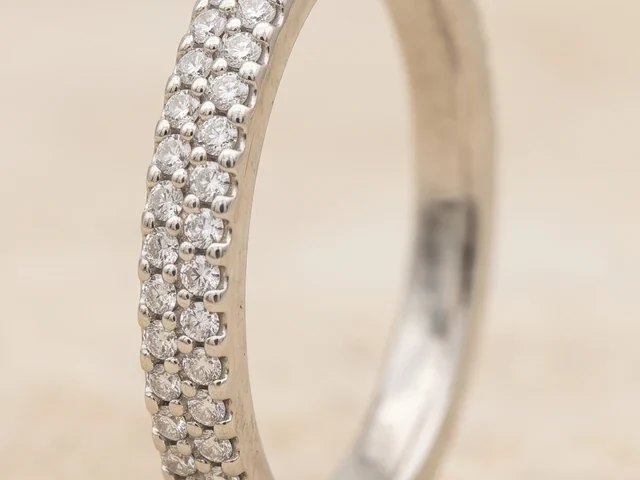
Pavé describes a way to arrange and secure small stones close together. Halo describes where the accents are arranged around the center. A ring may combine a halo with pavé on the shoulders or use only one of those details.
Can a jeweler add a halo to my solitaire later?
That depends on the current head and the stone dimensions. A jeweler may be able to replace the head or may need to make a new mount. Ask for an inspection and quote before assuming the existing band or warranty can carry over.
Can a halo ring sit flush with a straight wedding band?
Some designs leave clearance under the halo. Others project into the space where the band would sit. Try the exact pair and check from the side. A curved band or a different head can suit a close fit.
Does a halo listing’s total carat weight tell me the center size?
Request the center carat weight and face-up dimensions separately. Total carat weight can include the accents, so two rings with the same total can look quite different.