Emerald Cut vs Radiant Cut: How to Choose
Both cuts can give you a long, rectangular outline with clipped corners. Look at what happens inside that outline as you tilt each stone, then compare how the finished rings fit.

- Emerald Cut
- Broad, parallel step facets
- Radiant Cut
- Angled, subdivided facets
Emerald Cut vs Radiant Cut: Which Should You Choose?
Start with emerald cut if you like clean lines and broad flashes. Try radiant cut if you prefer a rectangular outline with smaller, livelier flashes. Compare two stones at a similar face-up size so you can judge the effect of the faceting.
Try emerald cut if
- You like an open-looking center and visible rows of facets.
- You want the outline to stand out in a simple setting.
- You can inspect the center for inclusions you’ll notice in wear.
Try radiant cut if
- You like many smaller flashes as the ring moves.
- You want to try both squarer and elongated outlines.
- You prefer a busy pattern that may make a small inclusion less noticeable.
Emerald and radiant cuts at a glance
Use the table to narrow your shortlist. Then compare the individual diamonds under the same light.
| Factor | Emerald Cut | Radiant Cut |
|---|---|---|
| Appearance | Clipped-corner rectangle with a broad, open-looking center. | Clipped-corner square or rectangle filled with angular reflections. |
| Faceting style | Step cut. Parallel rows follow the outline. | Modified brilliant. Angled facets divide the pattern. |
| Brilliance and fire | Broad returns can sweep across the stone as you tilt it. | Often shows more small white or colored flashes. The pattern varies by stone. |
| Visual character | Regular bands of light and dark. | Busier center. Some stones show a fine, crushed-ice look. |
| Shape proportions | Compare rectangle length, width, and corner clips. | Compare square and elongated profiles as separate looks. |
| Inclusion visibility | Check the open center for a mark visible at normal distance. | A busy pattern may make some inclusions less noticeable. |
| Face-up size | Compare length and width in millimeters. | Use the same measurements. Weight alone does not establish spread. |
| Setting | See how prongs or a bezel frame the long edges and clips. | Check corner coverage and the profile of the exact stone and basket. |
| Price | Inspect before paying for higher clarity or color. | Compare usable size, light pattern, and total setting cost. |
| Best fit | You value clear geometry and broad, deliberate-looking flashes. | You value a clipped-corner outline and more flicker as the ring moves. |
Choose by what matters to you
You wear mostly simple jewelry
Try an emerald solitaireLook for a stone whose steps stay easy to see as you move your hand.
You want a rectangular ring that catches your eye
Compare two radiants in motionSome have a fine twinkle, while others show larger flashes. Compare away from the display case.
You have a firm budget
Shortlist by finished-ring priceAsk what each stone costs in the same mounting. Choose after checking the face-up appearance of both.
Your ring has to sit beside a straight band
Try the actual stackBring the band or try a sample of the same width. Look for a gap and check whether the rings rub.
You mainly care how large it looks
Match the width firstTry two stone lengths at a similar width on your finger. Check whether the ring still feels comfortable.
Facets, white light, and colored flashes
Emerald cut
Broad step facets run in rows around the table, the large flat facet at the top. As the stone moves, whole rows can brighten or darken together. From above, start by looking for balanced steps on both sides. Then tilt the diamond and notice if a dark or see-through area persists through the angles you normally wear a ring.
Radiant cut
A radiant has more subdivided reflections in a clipped-corner outline. A square radiant looks compact, while an elongated one can come close to the silhouette of an emerald cut. Ask to see a video of the exact stone. Different radiants can show fine, dense flashes or larger patterns of light and dark.
Compare in two kinds of light
Brilliance is the return of white light. Fire is a colored flash, and scintillation is the change in bright and dark reflections as you move a stone. Compare both diamonds in soft daylight, then in a room with small light sources. Hold them low enough to see how they look at normal wearing distance. GIA’s guide to diamond shapes
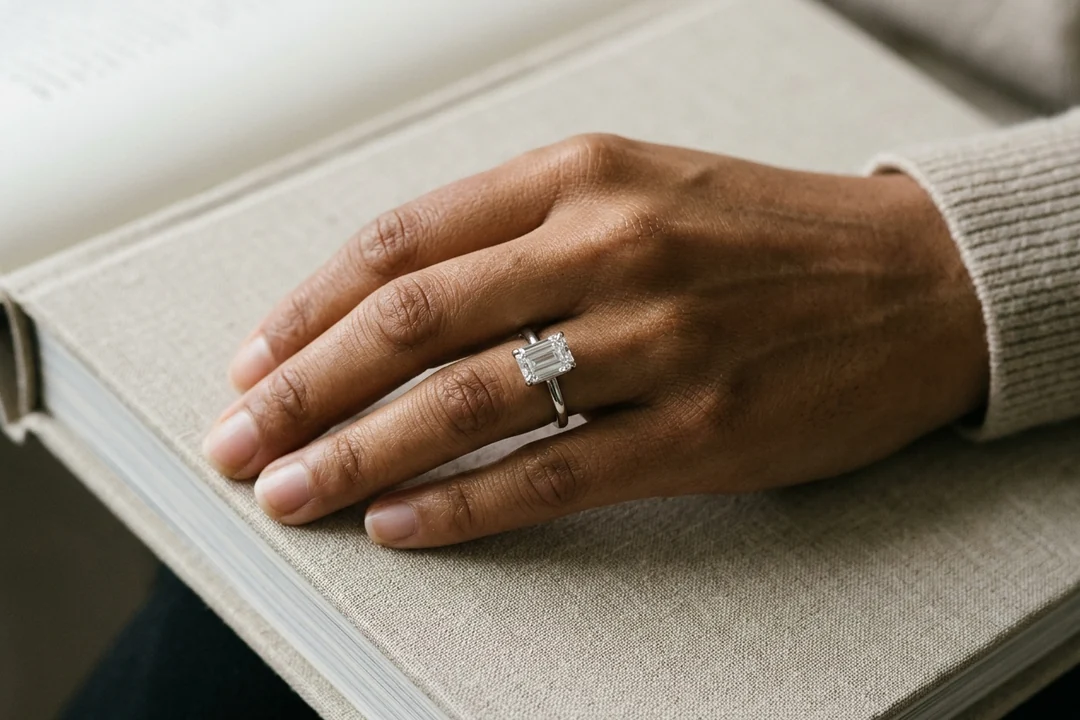
Face-up size and proportions on your hand
Ask each seller for length × width × depth in millimeters. Two diamonds can weigh the same yet look different from above. A deep stone can carry more of its weight below the girdle, the edge between the crown and pavilion. For the coverage you see on the hand, use length and width first.
Divide the length by the width to compare outlines. An 8.0 × 5.5 mm stone has a ratio near 1.45. An 8.0 × 6.2 mm stone is near 1.29 and will look broader at the same length. These are examples of proportions. Try the shape in your ring size before choosing a ratio.
For a phone comparison, ask for matching face-up photos of both rings with a millimeter reference and the stones turned the same way. If you’re ordering internationally, convert your ring size separately.
How to judge color and clarity
Start with the exact stone, face up, in neutral daylight. An emerald cut’s open center can make an inclusion easier to spot. Look at its position and contrast, then check it at normal wearing distance. A small mark near the side may matter less to you than a mark you see every time you look at the center.
A radiant’s smaller reflections can help hide some inclusions. Compare the outline and corners for tint and check the center as the bright flashes move. If you prefer a cooler look, try the diamond beside the metal you plan to use. GIA reports describe polish and symmetry on fancy shapes, but an overall GIA cut grade applies to standard round brilliants. IGI has its own fancy-shape cut criteria. Read the report for the exact stone and compare the video yourself. GIA cut grades · IGI cut grading
Price and the options you can actually buy
Either cut can cost more in a given shortlist. Ask for prices on the stones and the finished rings, then compare offers you would genuinely wear.
- Match the stone
- Keep origin, approximate face-up dimensions, and documentation comparable. Check weight, color, clarity, polish, and symmetry.
- Match the ring
- Price the same metal, setting, and any side stones. Include sizing, custom work, shipping, and applicable tax.
- Check stock and terms
- Ask if the exact diamond is available and how long it can be held. Read the return terms for both loose and set stones before committing.
If you’re open to natural and lab-grown diamonds, compare prices within each origin first. If you’re deciding between diamond and a different gem, see the moissanite and diamond comparison.
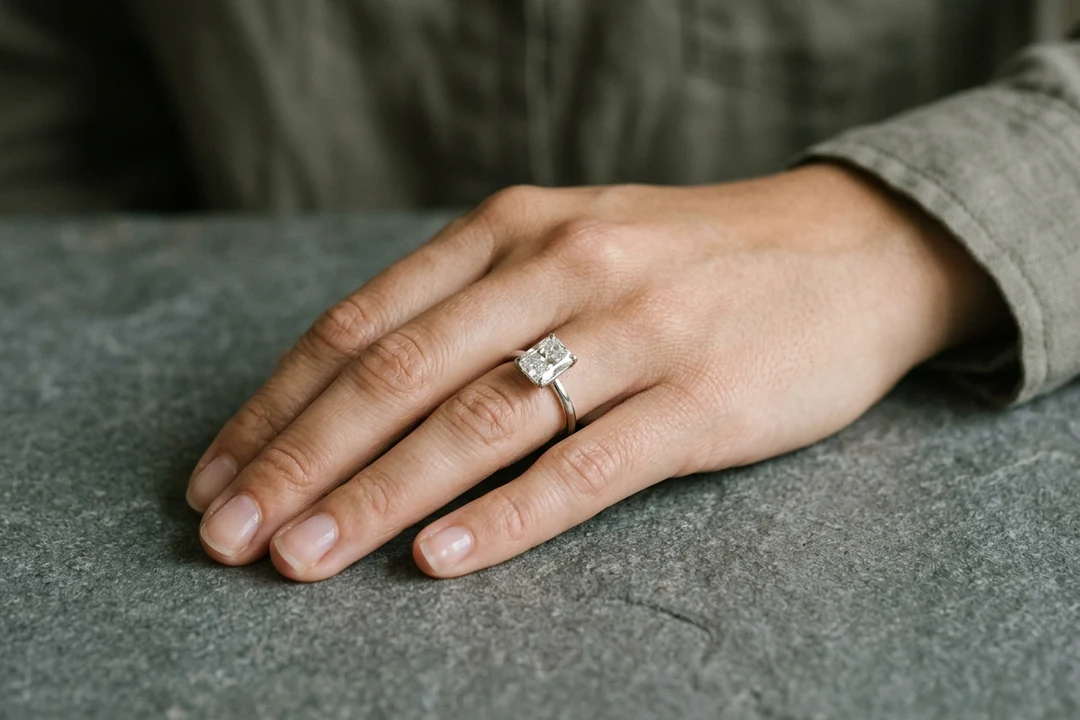
Choose the engagement ring setting
Try a simple prong setting if you want the clipped corners to stay visible. A bezel can frame the outline and shield the edge, while adding metal around the stone. Ask the jeweler to show how the setting supports the selected stone, including its corners and girdle.
For a ring you’ll wear most days, check the profile beside a straight band, slide your hand under a cuff, and make a fist. If the ring is set high enough to clear a band, check that you still like that height. Check side-stone or halo proportions with the exact center. For a white-metal mounting, compare platinum and white gold before requesting the final quote.
What to check before you buy
- Save the exact stone ID, lab report number, origin, and millimeter dimensions.
- Compare equal-sized stones in two lights and watch them turn.
- Check for any inclusion, tint, or persistent dark or see-through area you notice at normal distance.
- Try the ring on, inspect support at the corners, and check the fit beside your band.
- Request an itemized quote and read resizing, return, and repair terms before ordering.
Emerald and radiant cut FAQ
Can two radiant diamonds have different facet patterns?
Yes. A clipped-corner outline can contain different facet arrangements. A picture of one radiant is a starting point. Compare videos of the stones you can buy.
How can I recognize the two cuts from above?
Look for parallel, nested bands in an emerald cut and more fragmented, angular reflections in a radiant. Verify the cutting style on the seller’s listing and report.
Does an emerald cut need a particular clarity grade?
There’s no grade that guarantees a stone will look clean to you. Look at any inclusion’s location, size, and contrast from the top at normal distance. Ask for an unedited video with magnification as well.
Which cut looks bigger at the same carat weight?
Compare the measurements of the actual stones. Length, width, corner shape, and depth all affect how a given weight looks face up. Try both on your hand if you can.
Can I wear either cut in a bezel?
Yes, if it’s made to fit the exact stone. Ask how much metal will border the clipped corners, how high it will sit, and whether it will fit next to your band.
Does a report’s Excellent polish mean the stone sparkles more?
Polish describes facet surface finish. Look at the complete report and watch the stone move to judge the pattern you’ll see every day.
References
- How to Buy a Quality Diamond. Gemological Institute of America.
- How to Select a Radiant Cut Diamond. Gemological Institute of America.
- Emerald Cut Diamond Buying Guide. Gemological Institute of America.
- Fancy Shape Cut Grading. International Gemological Institute.