How to Tell if Gold Is Real
Start with the seller’s description, the stamp, and the spots that rub. These clues can show what to ask about. They cannot confirm the metal under a finish or establish karat on their own.

Start with a safe inspection
Read the receipt or listing first. Record the exact material, finish, and claimed karat. Then look at the parts of the piece that you can reach safely.
Five steps for a first look
- Save the seller’s description and any documents.
- Find and record the complete mark.
- Look at accessible areas that rub.
- Consider a magnet observation or dry weight only as a clue.
- Decide whether you need a jeweler to verify the claim.
What “gold” might describe
- Gold alloy throughout
- The metal part is a gold alloy from the surface through its section. A hollow piece can still be made of gold alloy.
- Gold filled
- A bonded gold-alloy layer over another metal. See how gold filled differs from gold plated.
- Gold plated
- Gold forms a surface layer. The rest of that part can be a non-gold metal, even if the surface really contains gold.
- Gold vermeil
- A gold finish on a sterling silver base that meets specific criteria. See the difference between vermeil and ordinary plating.
- Gold-tone base metal
- Brass or another alloy can look yellow without a gold-content claim. Ask what the seller means by the color.
Step 1. Check the markings
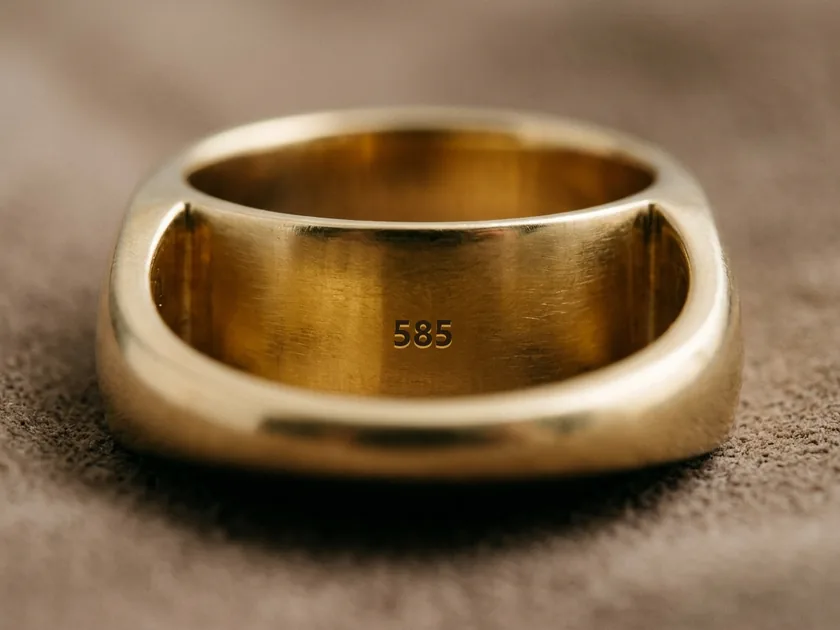
Write down the whole mark, including letters next to the number. A stamp makes a claim about a piece or part. It does not authenticate the claim, and a missing mark leaves the question open.
Read the number and letters together
Numbers such as 585 are parts per thousand, while K refers to parts per 24. Common pairings can differ slightly because marking conventions and nominal karat fractions are different ways to express content. Read the claimed fineness as written.
When a mark includes GF, GP, GEP, or HGE, the number can describe the surface gold rather than the article throughout. A stamp on an end tag or clasp should not be assumed to cover a whole chain. See Gold Hallmarks for the broader marking guide.
| Mark | What it usually claims |
|---|---|
| 10K / 417 | Common corresponding 10K-class marks. 417 expresses 41.7% gold. |
| 14K / 585 | Common 14K-class marks. 585 expresses 58.5% gold. |
| 18K / 750 | 750 expresses 75.0% gold, the 18K nominal fraction. |
| 22K / 916 | 916 expresses 91.6% gold, a common 22K-class designation. |
| 24K / 999 | 999 expresses 99.9% gold, commonly described as close to 24K. |
| GF | Gold filled. A bonded gold-alloy layer over another metal in this guide’s examples. |
| GP / GEP | Gold plated / gold electroplated. Any listed karat in that description refers to the layer. |
| HGE | Heavy gold electroplate. The term describes an electroplated finish, with specific criteria in U.S. guidance. |
Where to look for a mark
A mark can be tiny or worn. Use a loupe and turn the supported piece only as far as it moves safely.
Step 2. Inspect the surface
Look at corners, the inside of a ring, the clasp, and the small rings that join a pendant or chain. Record any change at a spot that rubs.
A color change at an edge can suggest that a layer has worn through. It can also reflect dirt, a repair, a join, a finish, or the light. Note the exact location. Color and gloss in a photo cannot tell you what the metal is.
If you see a seam or a mark near a stone, leave it intact. Ask what it means before cleaning or testing that area.
Step 3. Understand the magnet test
Pure gold is weakly diamagnetic. It does not show an obvious pull toward an ordinary household magnet. Many non-gold metals also show no pull.
If you do this check, leave the piece supported and bring the magnet near without touching or dragging it. Record what happens at each location. Some clasps have a steel spring, and alloys or separate fittings can behave differently from the main body.
A strong pull raises a question about the part that moves. No noticeable pull leaves the composition open. Neither result establishes karat.
Step 4. Interpret weight and density
A dry scale tells you mass. Density compares mass with volume. A jeweler may use the relationship when the item and comparison are suitable.
Gold alloys have different densities. Hollow construction, stones, solder, clasps, and other components affect the measured result. Small weighing or volume errors can also change the estimate. A figure for pure gold is not a pass/fail rule for a ring or chain.
Keep an unidentified piece dry. A water displacement check is unsuitable for many assembled, gem-set, glued, or fragile pieces. Ask a jeweler whether density adds anything to the assessment. Consult Gold Karats Explained for what karat actually measures.
What you can check at home and when to ask a jeweler
- At home
- Save the seller’s claim, record marks, inspect contact areas, and note what each non-invasive observation leaves unresolved.
- Ask a jeweler
- Confirm what the metal is when a decision depends on composition, coating, or fineness. Ask what can be verified without damaging the piece.
Popular gold tests and what each can show
Use observation to decide what to ask next. Skip household tests that abrade the surface, use chemicals, or rely on leaving a mark.
| Method | Can show | Does not prove | Damage risk | When to get help |
|---|---|---|---|---|
| Hallmark inspection | A claimed karat, fineness, coating, or maker. | Whether the mark is accurate or applies throughout. | Low when you just look. | A missing, altered, or inconsistent mark changes the decision. |
| Visual inspection | Wear, a seam, or a change worth pointing out. | The cause of a color change or the metal beneath. | Low when you just look. | Metal identity affects price, or wear is unclear. |
| Magnet check | Some magnet-responsive parts or metal. | Gold content, karat, or what a nonresponsive part contains. | Keep the magnet from snapping onto or dragging the item. | A response is unexplained or isolated to one part. |
| Weight and density | Whether an appropriate, simple specimen differs from an expectation. | Karat or construction of assembled, hollow, or gem-set jewelry. | Dry weighing is low-risk. Liquid exposure may harm some pieces. | The comparison requires measured volume or unknown parts matter. |
| Ceramic scratch test | A streak from whatever material contacts the ceramic. | A reliable gold identification, construction, or karat. | Can abrade metal, finish, or plating. Skip it. | Ask for a gentler assessment instead. |
| Vinegar test | A possible surface reaction or no visible change. | Gold content beneath a finish, or verified fineness. | Can affect some finishes or materials. Skip it. | Have the piece assessed without household chemistry. |
| Bite test | At most a dent or no visible mark. | Whether the metal is gold or a particular karat. | Can dent the piece or damage teeth. Skip it. | Ask for a method that suits the item. |
| Acid or touchstone test | A professional comparison of the sampled metal’s reaction. | Every layer or part when the sample comes from one location. | May remove a small trace or leave a mark. Reagents pose hazards. | Leave this to trained operators and ask what will be sampled. |
| Electronic gold test | An instrument-specific estimate from the contact area. | The composition beneath an unaccounted-for coating. | Some devices require preparation that can mark a finish. | Ask how calibration, coatings, and surface preparation are handled. |
| XRF analysis | Elements at chosen spots. Some setups can flag plating. | The composition of every layer or the entire piece from one reading. | Normally no metal removal at the measured spot. | Have a professional choose locations and interpret layer effects. |
| Professional assay | Gold content of a suitable, representative sample. | The composition of unsampled parts or the value of a design. | Some assays consume the sample, with irreversible removal. | Discuss representativeness and consent before sampling. |
How jewelers test gold
A professional starts with the question and the piece, then chooses where and how to test.
- Inspection first
- A jeweler can compare marks and finish, look at wear and joins under magnification, and choose test locations. This is useful before measuring, particularly if the piece has different components.
- Electronic testing
- Devices differ. Some estimate a karat range from a contact response. A clean, suitable contact and the right calibration matter. The result can be misleading if a coating is mistaken for the alloy.
- X-ray fluorescence (XRF)
- XRF identifies elements in the region sampled near the surface. Some instruments and measurements can flag plating. A gold-rich surface can also make the reading appear higher than the underlying alloy. A reliable reading at one location does not represent all layers or each component. Ask which spots were measured and what can be ruled out.
- Touchstone and laboratory assay
- Acid-based comparisons may evaluate a sampled trace. A lab can measure a representative sample with an assay such as fire assay, which consumes material. Ask what would be sampled and whether you need that degree of certainty before authorizing an invasive method.
GIA’s laboratory overview explains how XRF can detect some coatings and how the measured signal depends on the material. Ask whether the result describes a spot, a layer, or a sample taken from the item.
When to visit a jeweler
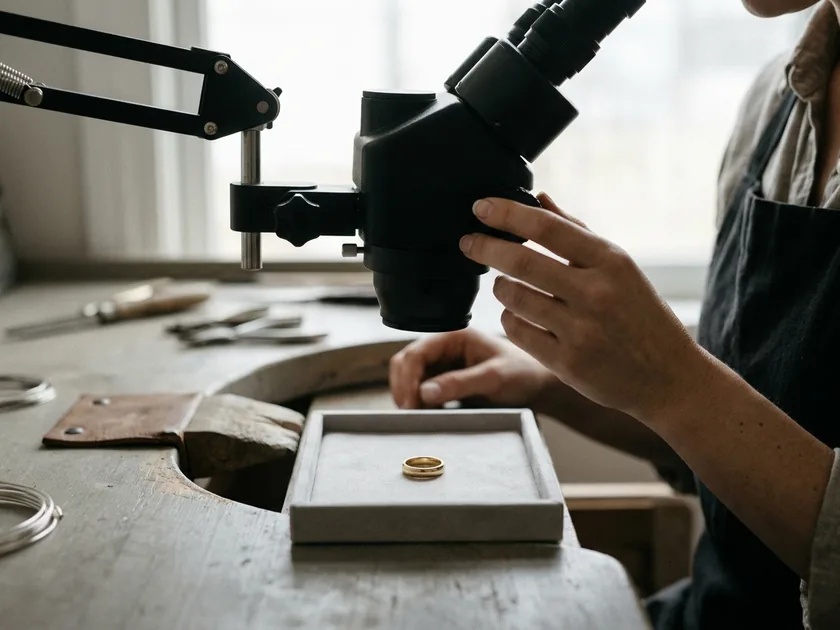
Ask for independent help if a material claim changes what you would pay, sell for, or do to a piece.
Expensive purchase
Check before committingAsk for the alloy and finish in writing, and whether an independent check is possible within the return period.
Inherited jewelry
Preserve the pieceBring records and family information. Ask about a non-destructive examination before any sampling.
Selling gold
Check what the price measuresAsk whether the buyer will separate stones, fittings, and different alloys from the gold-bearing weight and explain deductions.
No visible mark
Start with the designAsk which parts are accessible and what can be assessed without opening, filing, or removing anything.
Possible plating
Request a layer-aware assessmentShow the color change or wear point and ask how the method accounts for a coating.
Clues disagree
Ask for an explanationShow the marks and the responses for individual components. Ask why a method might give a different reading from the seller’s description.
Gem-set jewelry
Identify sensitive details firstTell the jeweler about treatments, glued elements, and prior repairs if known. Ask how the stones and settings will be protected.
Questions to ask before testing
- What are you trying to verify?
Ask whether the result addresses gold at the surface, the underlying alloy, or a particular claim in the sale listing. - Which parts will you examine?
Show a clasp, tag, seam, or wear point that concerns you. Ask how the method accounts for plating. - Could anything be marked or removed?
Explain any stones, repairs, or fragile areas. Ask what can be done without sampling and what requires consent. - How will the result be documented?
Ask for test locations, what the result does and does not establish, any charge, and whether a follow-up is needed.
Common questions about checking gold
Can I tell if gold is real from a photo?
A photo can help you ask about a stamp, seam, or worn spot. It cannot show what lies beneath the surface or whether a mark is accurate. Ask for documentation and an inspection when the answer matters.
Can gold jewelry be real without a stamp?
Yes. A mark may be absent or hard to see, including on small, worn, or repaired items. Its absence leaves the composition unresolved. A professional can choose a test suited to the piece.
How can I check a gold chain safely?
Set it on a soft tray and read the seller’s description. Inspect the clasp, end tag, connecting rings, and links separately. A tag can describe one part, and a clasp spring can react differently from the links.
How can I check a gold ring safely?
Look inside the band for marks and examine the edges, underside, and any repaired area under soft light. If a stone is loose or the ring is fragile, leave it on the tray and ask a jeweler to inspect it.
Does gold stick to a household magnet?
Pure gold is not pulled toward an ordinary household magnet. A clasp can contain a responsive part, and many base metals show no obvious pull. The result does not establish karat or authenticate the piece.
Does 14K GP mean a piece is 14K throughout?
No. In that marking, GP describes a gold-plated construction and the karat figure refers to the gold layer. Ask what the underlying metal is. A simple 14K stamp without GP is a different claim. Ask a jeweler to verify it if the answer matters to your decision.
Can XRF tell the difference between plated and unplated gold?
Sometimes. The instrument, coating, geometry, and sampling locations matter. A reading rich in gold can describe the surface. Ask how the operator assessed plating and what the report leaves open.
Is there one reliable home test for gold?
No single home observation establishes both construction and fineness. Combine the written description, marks and safe visual clues to decide whether a professional check is warranted.
References
- FTC Jewelry Guides for gold content and coatings. U.S. descriptions of gold alloys, filled construction, and electroplating.
- GIA’s comparison of jewelry-metal testing methods. What density, touchstone, electronic tests, and XRF can measure.
- Jewelers of America’s assaying overview. Why the surface and choice of sample matter.