Types of Necklace Chains Find a style you’ll want to wear
Among the most familiar types of necklace chains, cable and box give a pendant room to stand out. Rope catches the light in little flashes, curb shows every link, and herringbone reads like one ribbon of metal.
Types of necklace chains at a glance
Picture the necklace at arm’s length. Do you want to see daylight through the links, a raised pattern, or an almost unbroken band of metal? Then turn it sideways. Two chains that look equally wide from the front can sit very differently at the collar.
Open links that let the neckline show
Cable and rolo
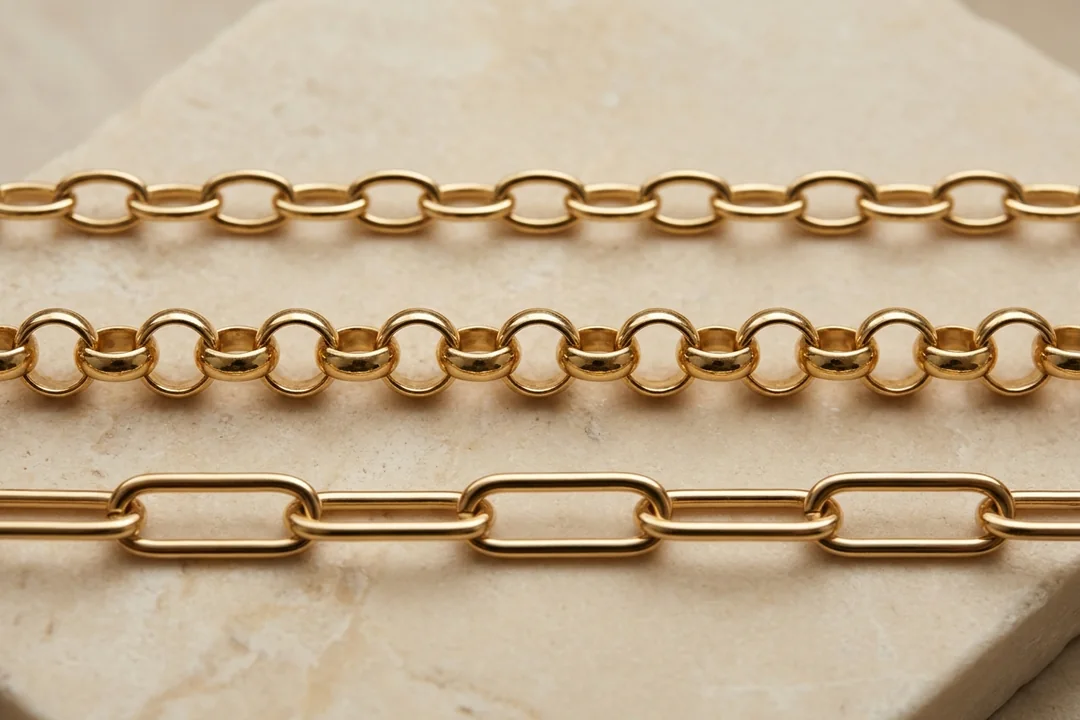
Cable links alternate direction. In a fine oval cable, the little openings recede against skin so a tiny charm stays in focus. The links articulate individually and follow the neckline easily. On a fine chain, check how the links close and how the end ring is attached. When you take it off, give it its own compartment so those small links stay out of knots.
Rolo, also labeled rollo or belcher in some shops, commonly uses rounder links with a fuller wire profile. It gives a plain chain more presence while keeping that easy drape. A fine rolo can carry a compatible pendant. With a chunkier example, check the bail across its narrowest point.
Paperclip and mariner
Paperclip is a long-link look, often sold as a variation of cable. Those elongated openings give a shirt or bare neckline room to show through. Turn your head and see how freely the links roll. Try it solo or with a charm designed to clip onto a link, and check whether the openings snag a loose knit you wear often.
A classic mariner has oval links crossed by a central bar, like an anchor chain on a ship. The bar breaks each opening into two windows. Flat versions sit close. Puffier versions stand off the skin, so compare a side view. “Anchor” varies by seller, so use the link close-up to confirm the shape.
Curb, Cuban link, and Figaro
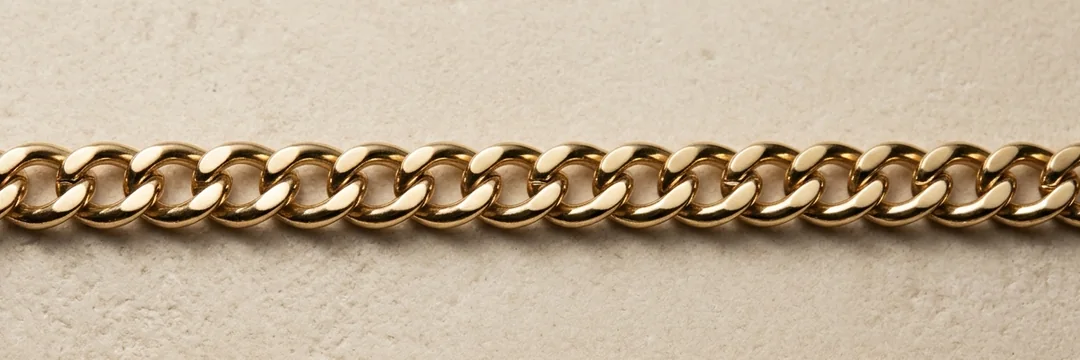
On a curb, the links are twisted to lie flat. A slim one skims the collarbone and can take a compatible slide pendant. A wider one reflects light in broad flashes and already has enough presence to wear alone. Look at the chain in profile to see what will sit under a collar.
Many Cuban links, especially Miami Cuban styles, are tightly packed members of the curb family. Their rounded shoulders give the outline a fuller look. Figaro brings a different rhythm to a flat chain with a long link followed by a run of shorter ones. Wear that changing pattern on its own or check whether a bail can travel over the long-to-short transitions.
Retailers may use these names differently. When a listing name leaves you guessing, compare a front and side view. Stuller’s chain-buying guide is a starting point for the styles to ask for.
Twists and weaves that do the work of a pendant
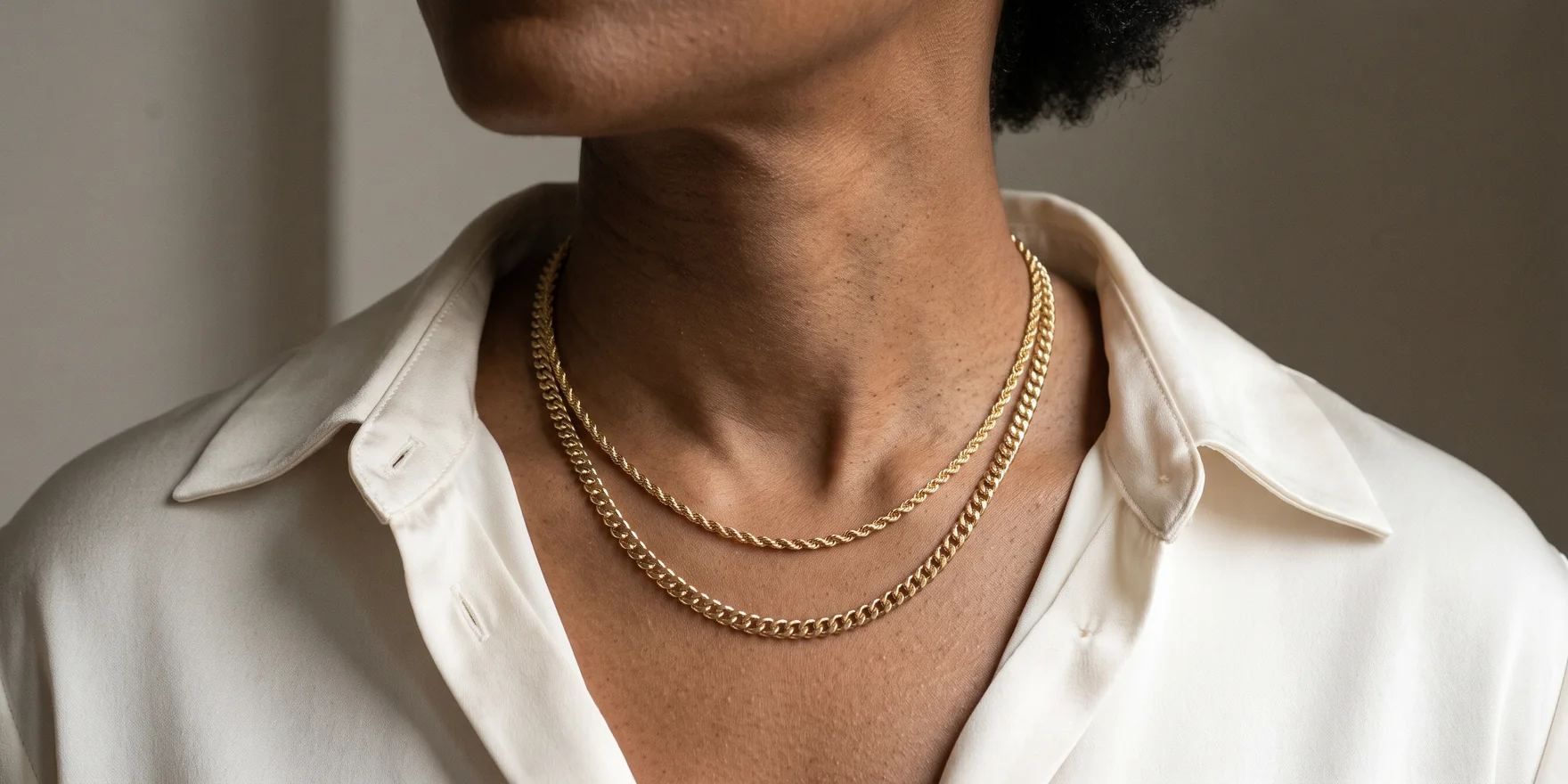
If you like a plain tee with one piece of jewelry, the surface of the chain can carry the look. A shallow twist glints as you move. A deeper weave adds shadows and can feel more substantial at the same apparent width.
Rope, wheat, and Singapore
Rope looks like a helix, with a highlight that travels around the chain. A fine rope can frame a pendant with enough clearance. A thicker one has a rounded profile you’ll feel under a close collar. Compare width and weight if two ropes look alike in photos.
Wheat, often called spiga, has a plaited grain. Its small diagonal repeats give it texture without the pronounced spiral of rope. It can drape in a neat arc and pair with a plain pendant if the bail moves freely along the weave. Singapore has a finer twist that flashes as its angled links turn. It’s a way to add shine to a simple neckline without going wide. Before adding a charm, check whether the twist moves freely through the bail.
Byzantine and Franco
Byzantine folds interlinked pairs of rings into deep repeating knots. The rounded weave can still articulate, but its raised pattern has a different feel under a collar than a flat curb. Try it alone and see how the extra depth sits against the neck.
Franco has a close weave and a square outline. Rotate a sample and look for the change from a curb-like face to a wheat-like face. A slender Franco can suit a pendant with a roomy bail. With a close weave like Franco or Byzantine, ask the maker how to care for the finish in the recesses. On broader versions, check both the depth and the width, especially if you want the chain to sit inside a buttoned collar.
Clean lines, from squared links to a sheet of shine
Box and ball
Box links have square shoulders, so a fine chain gives a pendant a clean, narrow line. Rounded box looks softer at the edges. Compare how the two bend through a bail. For ball or bead chain, look for small spheres joined by narrow connectors. The dotted line looks different from a strand of loose beads. Use a pendant designed to clear the spheres and move across the connectors. Check that the connectors and the matching end fitting sit securely before you wear it.
Snake and herringbone
A round snake chain is a closely fitted tube of small links. It gives a smooth sweep with few visible gaps. A lightweight slide can work if the maker allows it and the opening clears the chain. Lay the chain in a loose arc when you put it away so it stays free of sharp folds. A herringbone sits flat across the skin, and its broad face reflects light like a ribbon. Let it follow the neckline in a gentle curve. Jewelry maker Kinn recommends flat storage for its herringbone chains. A tight bend can leave a kink. Wear a thin herringbone solo unless its maker recommends a pendant.
Compare chains by how you’ll wear them
Use this shortlist when two chains catch your eye. Look at the actual piece in motion, especially if you’re shopping for a close neckline, a favorite pendant, or a gift.
| If you want | Try first | Check before buying |
|---|---|---|
| A subtle daily chain | Fine cable, box, or rolo | Can you work the clasp comfortably without a mirror? |
| A small pendant to read clearly | Fine cable or box | Is there enough clearance at the bail and the end fitting? |
| A dressier line of light | Herringbone or fine Singapore | Does the chain sit clear of the neckline as you turn? |
| An accent you can wear alone | Wide curb, Cuban, rope, or Byzantine | How do the weight and profile feel after a few minutes? |
| Two distinct layers | Paperclip with fine cable or box | Do the drapes remain separate when you sit and turn? |

Bring the pendant when you try the chain
There are two checks. First, will the bail, the loop at the top of the pendant, pass over the part you have to thread through? On a finished chain that’s often the end ring. Ask for its outside dimensions and compare them with the clear space inside the bail. Rio Grande’s guide to jewelry chain flags the end ring as a fit check for finished chain.
Then check how the pendant moves. It should hang facing forward, slide to its natural resting point and sit where you want it relative to the collar. For a substantial pendant, have the jeweler assess the whole setup, including the links, end ring and clasp. If the bail barely clears a textured chain, bring both pieces to a fitting.
Try the chain with the neckline you actually wear
Start with the shirt or jacket you reach for most. With a crew neck, try a slim box or cable that lands on either side of the fabric edge. If the chain rests right on the seam, it can keep slipping in and out of view. A subtle necklace is easier to see when it has a clear patch of fabric or skin behind it.
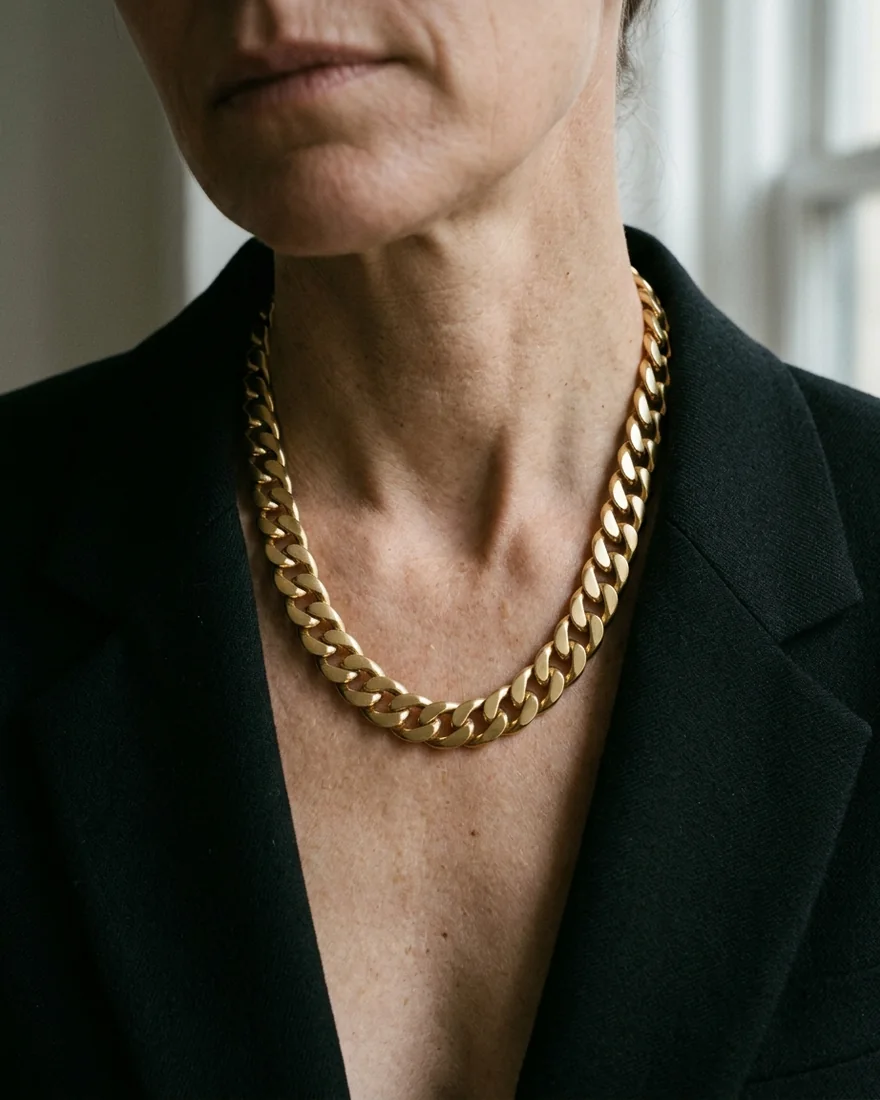
For a sharper line on an open jacket, let a flat curb sit against bare skin, where you can see the outline of each link. For an evening look with a little more movement, try a fine Singapore or rope. A herringbone can give you a single broad reflection with a simple dress or shirt. Try each in daylight; a wide polished face reads differently from small bright facets.
Buying a gift? Look at a necklace the recipient already wears. Note where it lands, whether they wear it with a charm, and what clasp they use. A rolo with a similar drape offers a small change in texture. An adjustable length or a clear exchange policy gives them room to choose the fit.

Layer one shape and one texture
Pick the necklace you want to see first. Let a paperclip sit higher and a fine chain hang lower, or put a small pendant below a quiet short chain. Leave enough visible space between the lowest point of the upper chain and the path of the lower one.
Check the pairing while you sit, turn and put on a jacket. Two fine chains can wind together when their arcs overlap. Try a bigger difference in drop, or replace one with a chain that has a visibly different width. A clasp extender can help you test the spacing if the chain can take one. Use an extender the maker approves for the piece.
With herringbone, keep anything layered above or below clear of its path. If the necklaces press across one another near the collar, give the flat chain its own day.
What to check before you pay
- Ask for a side view. Check the link profile, the seam and the attachment at each end. For online purchases, ask for a close-up of the actual piece and a photo on a neck or form.
- Compare the specifications together. Ask for width, length, gram weight, metal, and whether the links are hollow. A fuller-looking link can feel lighter. Compare listings at the same length when judging weight.
- Open and close the clasp. Look for an easy grip, clean closure and an end ring you can find by touch. With a pendant, check the entire threading path.
- Check the metal description. Compare the stated gold content with our guide to gold karats. If the gold is a surface layer, check the base metal and the difference between gold-filled and gold-plated jewelry.
- Plan how you’ll store it. Give chains separate spaces so they can’t rub or knot. Follow the maker’s guidance for flat styles and mixed materials. The National Association of Jewellers’ care guidance also suggests fastening chains before you put them away.
Link style tells you how the chain is built. For a chain you’ll wear often, check the metal, link dimensions, workmanship and condition together. Ask how the seller handles clasp service, kinks or a worn link.
Questions to ask at the jewelry counter
Is diamond-cut a type of chain?
It’s a finish. Facets on the surface pick up light as the necklace moves. You might see diamond-cut rope or diamond-cut cable, for example. Ask for the underlying link style if the listing only describes the finish.
Can a jeweler shorten a chain I already own?
Sometimes. Ask a jeweler to look at the material, link pattern and end fittings first. For something patterned like Figaro, also ask where the new clasp will meet the repeat. If it’s a gift, check the return terms before authorizing an alteration.
How can I identify a chain from an online photo?
Zoom in on the repeat, then ask for a picture at an angle. Look for the crossbar on a mariner, a longer link repeating among several shorter ones on a Figaro, or the packed diagonal rows of a herringbone. A photo taken from the front can hide how much a link rises off the skin.
Why does the clasp keep coming around to the front?
A necklace can rotate as it shifts against skin, hair, or a collar. Weight and placement of the clasp, end fittings, and any pendant can change how it moves. Check whether it still happens with a different neckline. If it persists, show the assembled piece to a jeweler.
Can a paperclip chain be worn at several lengths?
Only if the clasp is meant to close securely on the intermediate links or the chain has a designated adjustment section. Ask the seller which links, if any, are intended for the clasp. Look at where the unused length hangs when you wear it shorter.
What should I ask when buying a secondhand chain?
Ask for close-ups of the clasp, ends and any part with a different color or shape. Ask about prior repairs and for the actual length and weight. With a flat chain, a side view helps you spot raised or bent areas. Let a jeweler inspect a piece if the photos leave you unsure.