Gold Filled vs Gold Plated
How the gold gets there and what that means for wear
Gold filled is a good starting point for a piece you’ll wear often. It has a layer of gold alloy mechanically bonded to another metal and a minimum gold-alloy weight share under U.S. guidance. Gold plated jewelry has a surface coating and can make sense for an occasional style at a lower upfront price.

Gold filled and gold plated side by side
| What to compare | Gold filled | Gold plated |
|---|---|---|
| How it is made | Karat-gold alloy mechanically bonded to another metal. | Gold coating applied to a surface. Electroplating is one method. |
| How gold is specified | In the FTC example, at least 1/20 of the item’s metal weight is the bonded gold alloy. | Ask for the coating karat and thickness. A karat alone gives neither thickness nor gold weight. |
| What wear may reveal | The underlying metal can show where the bonded layer wears or is damaged. | The substrate or an intermediate layer can show where the coating wears away. |
| When to pay for it | Consider it for frequent wear when the seller can confirm which parts are gold filled. | Consider it for occasional wear or a lower upfront price. Check the finish and service options. |
What the gold layer looks like in cross section
Gold-filled sheet starts as a bonded stack that a maker can cut and shape. In electroplating, electric current deposits gold onto the exposed surfaces of a piece. These diagrams show two example constructions. The layer thickness is exaggerated, and the drawings show no measured dimensions.
Gold filled · double-clad sheet
- Karat-gold alloy bonded to both broad faces in this example. It can also be bonded to one face or formed around a core, depending on the stock.
- Brass core, visible at the cut ends of this sheet. Raw stock and a finished piece can have different exposed surfaces.
Gold plated · electrolytic example
- Electrodeposited gold follows the surface of the part. Actual coverage and thickness can vary with the part and the process.
- Underlying metal. Some pieces also have an intermediate layer, omitted here.
Conceptual diagrams, with no physical specimens or wear-test measurements. Rio Grande’s overview of gold-filled stock shows how fabricators and jewelers are supplied with different forms.
What does 1/20 14K GF mean?
Use the gold hallmark guide to read a stamp and the gold karat guide to interpret the purity stated for the gold layer.
The mark gives two different pieces of information. The fraction refers to the layer’s share of the article’s metal weight. The karat refers to the purity of that layer.
- 1/20
- One twentieth, or 5%, of the metal weight is the bonded gold alloy at that ratio.
- 14K
- The layer is nominally 14 parts gold out of 24 by weight.
- GF
- Gold filled. On a chain clasp, the stamp may describe the clasp alone. Ask what the links and any pendant are made of.
How much pure gold is that?
Imagine 20 grams of metal with exactly one twentieth of that weight in a 14K layer. One gram is 14K alloy, which contains about 0.58 grams of pure gold at nominal fineness. That is about 2.9% of the item’s metal weight in this example. Stones and other nonmetal parts would add to the scale weight.
How to read a plated mark
In a description such as 14K GP, GP indicates gold plate and 14K describes the layer. GEP indicates gold electroplate. Ask for the base metal and the coating thickness, especially if the listing shows only a close-up stamp or says “gold bonded” without a specification.
How U.S. FTC guidance treats the two labels
If the label says vermeil, see how gold vermeil differs from ordinary gold plating.
The FTC Jewelry Guides on gold content use a weight ratio for the gold-filled example and a fine-gold-equivalent thickness for the electroplate example.
Gold filled uses a weight ratio
The mechanically applied example calls for a gold alloy of at least 10K, reasonably durable coverage on all significant surfaces, and a layer weighing at least 1/20 of the metal in the article or part being described. The description also identifies the layer’s karat. That weight rule does not give you the layer’s thickness on a particular link or ring edge.
Electroplate uses a thickness example
The FTC’s electroplating example specifies at least 10K and at least 0.175 micrometers of fine-gold-equivalent thickness throughout the plating, with reasonably durable coverage on all significant surfaces. That number expresses the gold content as an equivalent layer of pure gold. The actual alloy layer can be thicker, and the figure does not describe every product sold as gold plated.
Where the gold wears and how to care for it
Look for repeated contact
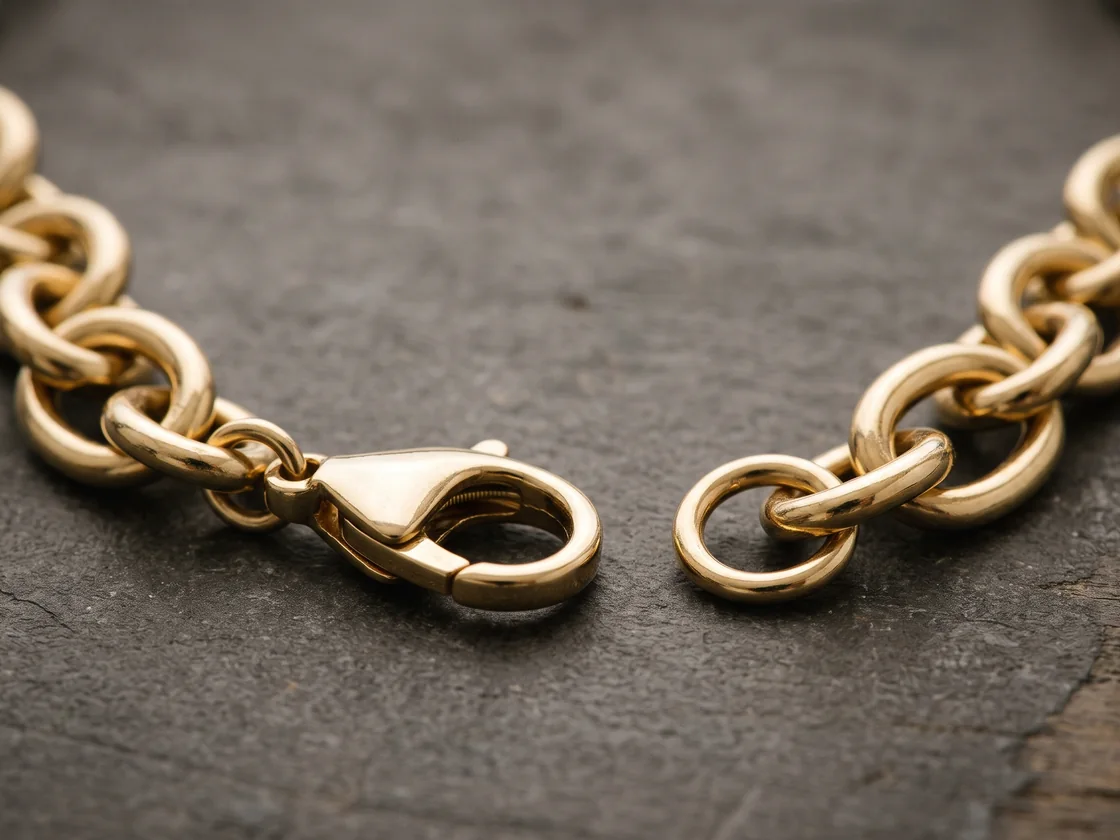
On a chain, look at the links that touch each other and the rings next to the clasp. On a ring, check the underside of the band and any edges that rub against another ring. Gold filled often gives you more gold alloy to wear through than ordinary light plating. Construction, contact, and local coverage determine where either piece will show wear first.
Check a dull patch after gently wiping it. Residue, scratches, and newly exposed metal look different under close inspection. If the color has changed at one contact point, ask a jeweler what has worn before trying to polish it out.
Clean gently and ask before refinishing
Use a soft, lint-free cloth and follow the maker’s instructions for the coating and any stones or adhesives. In Pandora’s jewelry care demonstration, the maker uses an untreated cloth on its plated lines and advises against ultrasonic cleaning. Remove coated pieces before swimming or using household cleaners. Avoid polishing pastes that take material off the surface.
Ask whether a worn piece can be replated, what the service costs, and whether it affects the original finish. Plating over a worn gold-filled piece can restore its appearance without restoring the original bonded layer.
When is gold filled worth paying more for?
If you are also shopping for a solid-gold alloy, compare 14K and 18K gold.
Compare the same type of jewelry, dimensions, and finish. Gold filled can cost more than a comparable lightly plated item. The actual price also reflects the base metal, labor, stones, brand, and service. Ask what the seller will repair and which parts the material description covers.
Everyday chain
Start with gold filled
Confirm the links, clasp, and end rings separately. A gold-filled clasp is of limited use if the links that rub together are lightly plated and the seller cannot replace them.
Occasional statement earrings
Consider gold plated
If you want the design for occasional wear, compare the price, weight, and comfort. Ask what the posts and backs are made of, even if the visible part has a gold finish.
Ring or bracelet worn daily
Check repair options first
Look at wear points, then ask about resizing or replacing a clasp. If you want repeated refinishing, get a repair quote and compare it with a karat-gold piece without a surface coating.
Gold filled and gold plated jewelry FAQ
Is gold filled real gold?
Yes, there is real karat-gold alloy in the bonded surface layer. The core is another metal. A 14K gold-plated piece can likewise have real 14K gold alloy in its coating, with a different way of applying and specifying that layer.
Can gold-filled jewelry tarnish?
Yes. The metals mixed into the gold alloy can discolor, and exposed base metal can change color as well. Oils and product residue can also dull the surface. Start with the recommended cleaning method before assuming the layer has worn through.
Can you shower in gold-filled or gold-plated jewelry?
Taking it off is the simplest way to avoid repeated contact with soap, shampoo, and moisture. Check the seller’s instructions for the whole piece, including any stones, glued parts, or dissimilar metals.
Can you identify gold filled from a listing photo?
A photo can show finish and wear, but neither color nor shine identifies how the layer was applied. Ask for the exact stamp and a written description for each relevant part. Have a jeweler examine an inherited or secondhand piece if its value depends on what it is.
Which is better if you react to nickel?
Ask about the gold layer, any undercoat, and the metal in posts, backs, and clasps. The label alone cannot tell you what contacts your skin at a worn spot. The American Academy of Dermatology’s nickel-avoidance guidance suggests checking jewelry for nickel exposure.
Is gold-filled jewelry worth more at resale?
Possibly. A buyer can value a finished piece for its maker, condition, and design. An offer for recovery of the metal depends on the verified content, recoverable weight, and the buyer’s terms. A 14K GF stamp alone is insufficient for a quote.